AI Has an Intern Problem
Everyone is using AI right now.
That is not the issue.
Founders are using it to think through business models, sales decks, investor notes, hiring plans, and occasionally to make a simple thought sound like it belongs in a McKinsey report.
Developers are using it to write code, debug errors, understand unfamiliar systems, document logic, and sometimes to convince themselves that the bug was definitely not their fault.
Marketing teams are using it for campaign ideas, competitor scans, first drafts, rewrites, captions, subject lines, and those “just give me 20 options” moments that usually end at option three.
HR teams are using it for JDs, policies, resume screening, internal communication, and performance review language that sounds warm but still slightly terrifying.
Finance teams are using it to summarise reports, read sheets, extract patterns, and explain numbers in a way that does not immediately make everyone else leave the room.
Somewhere, someone is definitely using it to write a two-line email that now sounds like a TED Talk with bullet points.
So yes, AI adoption looks strong.
But inside most organisations, something stranger is happening.
AI is being used everywhere, and still transforming very little.
That sounds contradictory, but it is not. There is a difference between individuals using AI and an organisation becoming AI-enabled. The first is easy. The second is where most companies are getting stuck.
The way I see it, companies are falling into two broad camps.
One camp treats AI like a very smart tool. The other treats AI like a new operating layer.
The first camp asks, “How can this person use AI to finish this task faster?” The second asks, “How should work itself change now that AI exists?”
That difference sounds small but it is not. The tool camp is busy buying subscriptions, running prompt workshops, sharing prompt sheets, and encouraging teams to experiment. None of this is wrong. In the early phase, it is probably necessary. But after the first few weeks of excitement, most teams realise that AI can generate output, but the output still needs context, correction, validation, rewriting, alignment, and sometimes a quiet apology before it can actually be used.
That is when AI stops feeling like magic and starts feeling like another person to manage.
Which, honestly, is not a bad way to think about it.
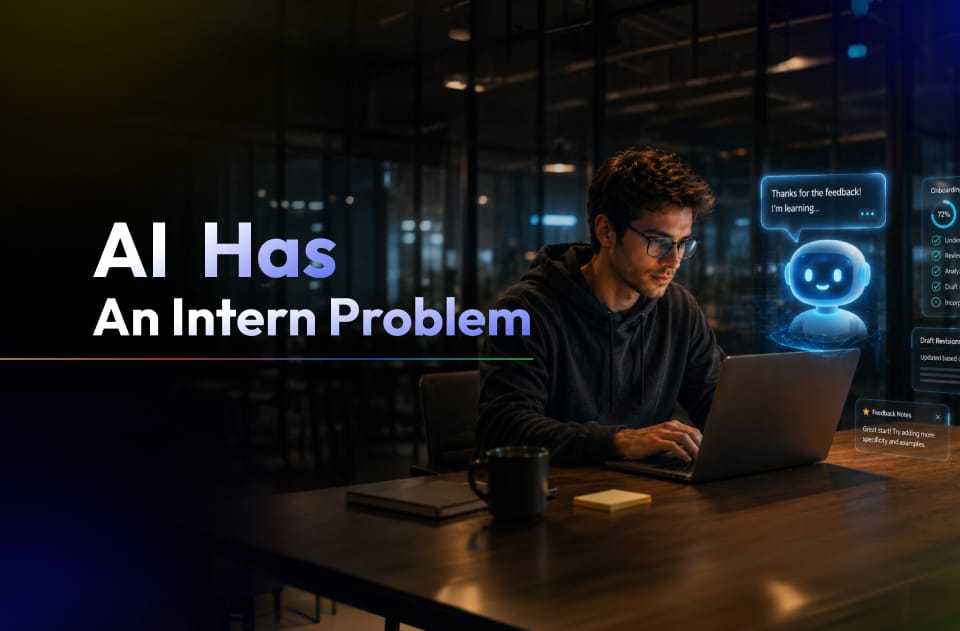
AI inside an organisation is a lot like a smart, intelligent, well-informed intern. Fast, curious, widely read, eager to help, and capable of producing surprisingly impressive work when guided well. It does not get tired. It does not complain. It can absorb a lot. It may even occasionally say something that makes you wonder if it understands the business better than a few people in the room.
But it is still an intern.
And the thing about interns is that intelligence is not the same as judgment.
If you give them vague instructions, they will give you vague output. If you do not explain the context, they will fill the gaps with confidence. If you do not tell them what matters, they will optimise for what sounds right. If you do not give them boundaries, they will try to help in places where they should have stopped.
Ask AI to write code, and it may write code. Ask it to review the code, update the documentation, fix the design, summarise the meeting, clean the backlog, draft the client note, and maybe make the logo bigger while it is at it, and you have not created leverage.
You have created a very polite mess and this is where the two camps begin to separate. The tool camp keeps asking the intern to do more. The system camp teaches the intern how the company works.
That is the real unlock.
Most AI failures are not model failures. They are context failures. The model is not the problem as much as the environment around the model.
AI does not automatically know the current state of a project. It does not know why a decision was taken three months ago. It does not know which client requirement is non-negotiable. It does not know which integration broke last time. It does not know the design system, the engineering pattern, the QA history, the business priority, or the one exception that everyone remembers but nobody documented.
So it does what any smart intern would do – It makes a reasonable assumption. And in organisations, reasonable assumptions are where rework begins. This is why I believe prompting has been over-romanticised.
Prompting matters, of course. A bad prompt can turn even the best model into a confident generalist with excellent grammar and limited usefulness. But the real advantage is not in writing clever prompts. The real advantage is in building a company where AI has access to the right context, follows the right standards, and works inside the right workflow. Without that, AI becomes impressive at the surface and fragile in execution.
A lot of companies are still in the experimentation phase and calling it transformation. Different teams use different tools, different prompts, different standards, and different levels of judgment. One person gets a great output. Another gets something unusable. A third person spends twenty minutes correcting the output and still says AI “saved time” because the first draft appeared quickly.
That is not transformation.
That is uneven productivity with better packaging.
The system camp behaves differently. It does not only ask, “Which AI tool should we use?” It asks what AI should know before it starts, what it should never assume, what good output looks like in that specific environment, where human judgment must enter, where AI needs supervision, and how the output can be made repeatable across people, teams, and projects.
These questions are less exciting than a new tool demo. Naturally, they matter more. Because organisations do not scale on enthusiasm, they scale on proven successful repeatability.
This is especially true in technology and digital delivery. Real work does not move in one giant leap from requirement to output. It moves through interpretation, planning, execution, review, testing, documentation, deployment, and learning. When companies ask one AI system to do everything, they usually recreate the same confusion faster.
The better approach is to break work into smaller, more intelligent units. One workflow understands the requirement. Another helps convert it into a plan. Another supports implementation. Another reviews consistency. Another checks risk. Another helps with testing. Another keeps documentation alive.
The point is not to replace the chain of work. The point is to make the chain sharper, faster, and less dependent on memory. This is where AI starts becoming useful at scale. Not when it answers one person faster, but when it helps work move better from one stage to another.
The other big mistake is treating documentation like a formality. Every organisation says documentation matters. Most organisations treat it like a storage room. Things are put there when the work is done, nobody really wants to go inside, and years later someone opens it to find outdated screenshots, broken links, and a file called final_final_latest_v3.
AI exposes this problem brutally.
If organisational knowledge is scattered across chats, calls, decks, emails, ticket comments, people’s memory, and that one senior person who “just knows,” then AI will behave like a new joiner walking into a messy company. It will either keep asking for context or, worse, stop asking and start guessing.
But when knowledge is structured well, documentation changes its role. It stops being a record of what happened and becomes an input into how work happens. It can guide decisions, reduce repeated explanations, preserve project memory, improve onboarding, and help AI behave less like a random assistant and more like someone who understands the room.
That is when AI starts becoming organisational memory, not just individual productivity.
This is also why I do not believe the future of organisational AI will be decided only by which model is better.
Models will keep changing. Tools will keep changing. Interfaces will keep changing. Every few months, someone will announce that the old favourite is dead and the new one is the only thing that matters. Then a new release will drop, everyone will migrate emotionally, and the cycle will begin again. That is not a strategy, rather tool tourism.
Companies that build only around tools will keep moving from one shiny object to another. Companies that build around capabilities will get stronger over time.
Requirement analysis is a capability. Code review is a capability. Design validation is a capability. QA planning is a capability. Documentation is a capability. Performance analysis is a capability. Decision support is a capability.
Once a company defines the capability clearly, the tool becomes replaceable. The operating intelligence stays. This is where the intern analogy comes back.
A good intern becomes valuable over time because the organisation invests in their context. They learn the standards, understand the people, remember previous mistakes, know when to move fast, and know when to ask. They stop giving generic answers and start making useful decisions. Eventually, if guided well, they become the person everyone trusts. AI needs a similar path.
Most companies are still treating it like a genius outsider who should perform instantly because the model is powerful. But inside an organisation, intelligence without context is not enough. Speed without judgment creates more work. Output without ownership creates confusion. Automation without structure creates noise.
So when people ask why AI adoption is failing, I do not think the answer is that AI is overhyped. I think the answer is that most organisations are underprepared.
They are adding AI to broken workflows, scattered knowledge, unclear ownership, inconsistent standards, and departments that already struggle to talk to each other. Then they expect transformation.
AI does not hide that chaos. It reveals it.
And maybe that is why the conversation around AI feels so uncomfortable. It is not just asking companies to adopt new tools. It is forcing them to look at how work actually moves, where knowledge actually sits, how decisions actually happen, and how much of the organisation still depends on memory, habit, and heroics.
The companies that move ahead will not be the ones using AI the most loudly. They will be the ones that quietly redesign how work moves around it.
They will give AI context, boundaries, standards, memory, review loops, and a clear role in the system. They will not treat AI like a shortcut. They will treat it like a new colleague who can become exceptional, but only if the organisation knows how to train, guide, and integrate it.
Because that is the thing about a smart intern. Left alone, they create work. Guided well, they become a star employee.
At KartmaX, that is the direction we are building towards. Not AI as a shiny layer on top of work. AI as a more intelligent way for work to move.
- Sagar Chauhan (Head of Product at KartmaX)